
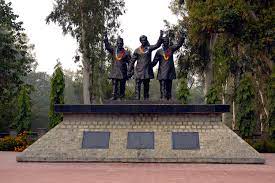
Bhagat Singh, Rajguru, and Sukhdev
Bhagat Singh, Rajguru, and Sukhdev were young revolutionaries who played a crucial role in India’s struggle for independence. Born in the early 1900s, all three were deeply influenced by the fierce nationalism that was sweeping through India at the time. They were inspired by the work of Mahatma Gandhi and other leaders of the freedom movement, but their methods and goals were very different. They believed that violent rebellion was necessary to achieve India’s liberation from British rule, and they were willing to risk their lives for the cause. In this article, we will explore the lives and legacies of these three iconic figures of the Indian freedom struggle.
Bhagat Singh – The Firebrand Revolutionary
Bhagat Singh was born in September 1907, in the district of Lyallpur (now Faisalabad) in present-day Pakistan. His father, Kishan Singh, was a Sikh farmer who had been involved in various progressive and socialist movements. Bhagat Singh grew up in a politically charged atmosphere and was exposed to revolutionary ideas from a young age. He was particularly influenced by the writings of Marx, Engels, and Lenin.
At the age of 16, Bhagat Singh left school and joined the National College in Lahore. It was here that he came into contact with other young revolutionaries, including Sukhdev Thapar and Shivaram Rajguru. Together, they formed the Hindustan Socialist Republican Association (HSRA), a revolutionary group that sought to overthrow British rule through armed struggle.
In 1928, Bhagat Singh and his comrades launched a daring attack on the British police. They threw a bomb in the Central Legislative Assembly in Delhi and shouted slogans demanding Indian independence. Bhagat Singh and his accomplices were arrested, and he was charged with murder and conspiracy. During his trial, Bhagat Singh used the courtroom as a platform to espouse his revolutionary ideas. He informed the court that he had thrown the bomb not with the intention of causing harm but to draw attention to the plight of Indian political prisoners.
Bhagat Singh also went on a hunger strike while in prison to protest against the inhumane treatment of political prisoners by the British authorities. His hunger strike lasted for 116 days, and it became a rallying point for Indians across the country. Bhagat Singh’s trial and his hunger strike turned him into a national hero and a symbol of resistance against British oppression.
On 23 March 1931, Bhagat Singh and his comrades Rajguru and Sukhdev were hanged to death by the British authorities. Their execution sparked widespread outrage across India, and their sacrifice became a rallying point for the freedom struggle. Bhagat Singh’s legacy lives on, and he is remembered as a firebrand revolutionary who was willing to give his life for the cause of Indian independence.
Rajguru – The Fearless Patriot
Shivaram Rajguru was born in August 1908 in Khed in present-day Maharashtra. His father was a farmer, and his family was involved in the Indian independence movement. Rajguru was a gifted student, and he completed his high school education by the age of 14.
Rajguru was deeply influenced by the ideas of Bhagat Singh, and he joined the Hindustan Socialist Republican Association (HSRA) in 1928. He became one of the key members of the group and worked closely with Bhagat Singh and Sukhdev Thapar.
Rajguru played a crucial role in the assassination of a British police officer, J.P. Saunders, in 1928. Saunders was responsible for lathi-charging a peaceful protest led by Lala Lajpat Rai, a prominent leader of the freedom movement. Rai was seriously injured in the lathi-charge and died a few weeks later. Bhagat Singh and his comrades were determined to avenge Rai’s death, and they decided to target Saunders.
On 17 December 1928, Saunders was shot dead by Bhagat Singh and Rajguru outside his office in Lahore. The two fled the scene and went into hiding. They were eventually arrested and charged with murder and conspiracy.
Rajguru was only 21 years old when he was executed by the British authorities on 23 March 1931, along with Bhagat Singh and Sukhdev. Rajguru’s bravery and patriotism inspired generations of Indians to fight for their freedom. He is remembered as a fearless patriot who was willing to lay down his life for the cause of Indian independence.
Sukhdev – The Quiet Revolutionary
Sukhdev Thapar was born in May 1907 in Ludhiana, in present-day Punjab. His father was a government employee, and the family was not actively involved in the freedom movement. Sukhdev was a brilliant student and was known for his quiet and reserved nature.
Sukhdev met Bhagat Singh and Shivaram Rajguru at the National College in Lahore in the early 1920s. The three became close friends and shared a passion for revolutionary politics. Sukhdev played a key role in the formation of the Hindustan Socialist Republican Association (HSRA) and was instrumental in planning several acts of sabotage against the British authorities.
Sukhdev was involved in the killing of J.P. Saunders, along with Bhagat Singh and Rajguru. He was arrested along with his comrades and was charged with murder and conspiracy.
Sukhdev was executed by the British authorities on 23 March 1931, along with Bhagat Singh and Rajguru. His quiet and unassuming nature belied his fierce commitment to the cause of Indian independence. Sukhdev’s sacrifice inspired many young Indians to join the freedom struggle, and he is remembered as a quiet revolutionary who played a crucial role in India’s struggle for independence.
Conclusion
Bhagat Singh, Rajguru, and Sukhdev were young revolutionaries who were driven by a fierce passion for India’s freedom. They were willing to risk their lives to achieve this goal and were instrumental in inspiring a generation of Indians to join the freedom struggle. Their legacy lives on, and they continue to inspire younger generations to fight for justice and equality. The sacrifices they made will never be forgotten, and their memory will always be a source of inspiration to all those who seek to build a better India.