
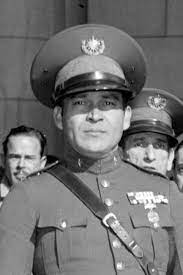
Fulgencio Batista
Fulgencio Batista was a Cuban political figure who rose to power through a military coup and ruled Cuba for several years before being overthrown in a revolution led by Fidel Castro. His presidency was marked by corruption, repression, and economic inequality, and his legacy remains controversial to this day.
Introduction:
Fulgencio Batista was born on January 16, 1901, in Banes, a small town in eastern Cuba. He was the son of impoverished farmers and received little formal education, dropping out of school at the age of 14. Despite this, he showed an early interest in politics and joined the army at the age of 19, where he quickly rose through the ranks.
After several years in the army, Batista became involved in politics and was elected to the Cuban Congress in 1934. However, he soon became disillusioned with the political process and staged a military coup in 1933, seizing power and becoming the de facto ruler of Cuba.
Social:
Batista was a controversial figure in Cuban society. On the one hand, he was seen as a strong and decisive leader who brought stability to the country after years of political turmoil. He was also admired for his efforts to modernize the country’s infrastructure and improve its economy.
However, Batista’s rule was also marked by repression, corruption, and human rights abuses. He used the military and police to suppress political dissent, and many of his opponents were arrested, tortured, or killed. He also enriched himself and his associates through corrupt practices, including kickbacks and embezzlement.
Education:
As mentioned earlier, Batista received little formal education, dropping out of school at the age of 14. However, he was a quick learner and had a natural talent for military strategy and political maneuvering.
Achievements:
Despite his controversial legacy, Batista did make some significant achievements during his presidency. One of his main goals was to modernize Cuba’s infrastructure, and he oversaw the construction of new highways, bridges, and other public works. He also invested heavily in the country’s tourism industry, which helped to boost the economy and create jobs.
Batista also implemented a number of social welfare programs, such as free school lunches and medical care for the poor. He also supported labor unions and increased the minimum wage, which helped to improve the lives of many working-class Cubans.
Tragedy:
However, Batista’s achievements were overshadowed by his repressive and corrupt practices. He used the military and police to suppress political opposition, and his regime was responsible for numerous human rights abuses. Many Cubans lived in poverty and were excluded from the benefits of his economic policies, leading to growing resentment and unrest.
In 1959, Batista was overthrown in a revolution led by Fidel Castro, which marked the beginning of a new era in Cuban history. Batista fled the country and went into exile in the United States, where he remained until his death in 1973.
Legacy:
Batista’s legacy remains controversial to this day. Some see him as a strong and decisive leader who modernized Cuba and improved the lives of its citizens. Others see him as a corrupt and repressive dictator who enriched himself at the expense of the Cuban people.
Despite the controversy surrounding his legacy, there is no doubt that Batista played a significant role in Cuban history. His rise to power through a military coup and his use of repression and corruption to maintain control are cautionary tales for future generations of political leaders.