
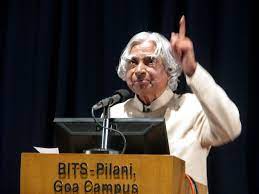
APJ Abdul Kalam
APJ Abdul Kalam, also known as the Missile Man of India, was an Indian scientist and statesman who served as the 11th President of India from 2002 to 2007. He was born on October 15, 1931, in Rameswaram, Tamil Nadu, and passed away on July 27, 2015, while delivering a lecture at the Indian Institute of Management, Shillong.
Kalam was the youngest of five siblings and his family belonged to a humble background. His father, Jainulabdeen, was a boat owner who ferried pilgrims from Rameswaram to Dhanushkodi, a town located at the tip of the Pamban Island. His mother, Ashiamma, was a housewife who took care of the family. Kalam had to do various odd jobs during his childhood to support his family and pay for his education.
Kalam graduated from Saint Joseph’s College, Tiruchirappalli, with a degree in physics in 1954. He then joined the Madras Institute of Technology to study aerospace engineering. Kalam was a brilliant student and secured a scholarship to study at the Massachusetts Institute of Technology (MIT) in the United States. He earned a master’s degree in aerospace engineering from MIT in 1960 and a doctorate in the same field from the University of Edinburgh in Scotland in 1958.
After completing his studies, Kalam returned to India and started his career as a scientist at the Defense Research and Development Organisation (DRDO), where he worked on India’s space and missile programs. He was also instrumental in the development of India’s guided missile program, which led to the successful test-firing of the Agni and Prithvi missiles. Kalam also played a pivotal role in the development of the Polar Satellite Launch Vehicle (PSLV), which was used for the launch of India’s first satellite, Aryabhata.
In 1992, Kalam was appointed as the Chief Scientific Adviser to the Prime Minister of India and the Secretary of the Defense Research and Development Organisation. He continued to serve in these positions until 1999 when he retired from government service. Kalam was then appointed as the Chancellor of the Indian Institute of Space Science and Technology (IIST) in Thiruvananthapuram and the Professor of Aerospace Engineering at Anna University in Chennai.
Kalam was known for his simplicity and his passion for education. He believed that education was the key to success and that the youth of India should be empowered with knowledge and skills to face the challenges of the 21st century. He authored several books on education, including Wings of Fire, Ignited Minds: Unleashing the Power Within India, and The Luminous Sparks.
Apart from his contributions to science and technology, Kalam was also a great leader and served as a role model for millions of people. He was known for his humility and his devotion to his country. In 2002, he was sworn in as the 11th President of India, succeeding K. R. Narayanan. Kalam served as the President of India for five years and was widely regarded as one of the most popular and beloved Presidents in Indian history.
As the President of India, Kalam continued to work towards his vision of a developed and prosperous India. He was a strong advocate of innovation and urged the youth of India to become entrepreneurs and create new opportunities for themselves and others. He also championed the cause of education and launched several initiatives to promote science and technology education in the country.
During his presidency, Kalam played an active role in foreign policy and worked towards strengthening India’s ties with other countries. He visited several countries, including the United States, China, and Japan, and worked towards promoting India’s interests across the globe. He also played a crucial role in the successful conclusion of the India-US nuclear deal, which was signed in 2008.
Kalam’s presidency was marked by his strong commitment to national development and his focus on science and technology. He was a great champion of the underprivileged and worked tirelessly to uplift the poor and marginalized sections of Indian society. He also promoted a culture of peace and harmony and called for greater understanding and cooperation among different religions and communities.
Apart from his contributions to science and technology and his leadership as the President of India, Kalam was also a great inspiration to millions of people. He was known for his motivational speeches and his ability to connect with people from all walks of life. He was a great advocate of hard work, determination, and courage, and urged the youth of India to follow their dreams and make a difference in the world.
Kalam’s life and legacy continue to inspire people across India and the world. He was a true patriot and a great leader who devoted his entire life to the service of his country. His contributions to science and technology, his leadership as the President of India, and his message of hope and inspiration will continue to inspire generations of Indians in the years to come.